
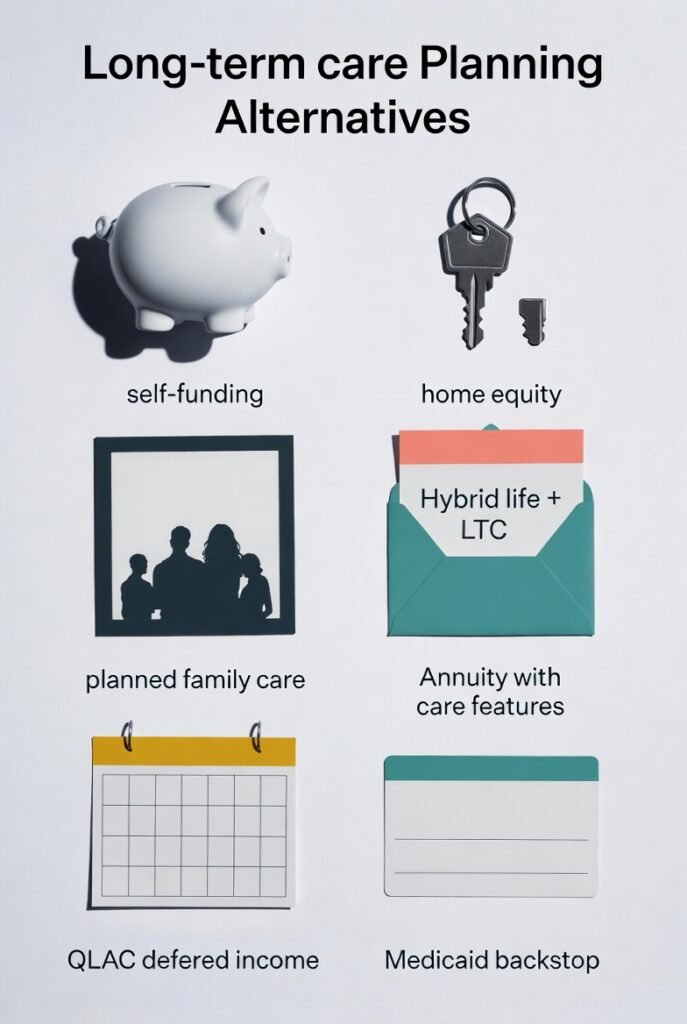
Alternatives to Long Term Care Insurance
People don’t usually search for alternatives to long term care insurance because they’re casually browsing. They search because something doesn’t fit: the premium is higher than expected, underwriting feels uncertain, or the terms feel rigid compared to how care actually happens.
If that’s you, here’s the boundary that matters most:
An “alternative” doesn’t remove risk. It moves it.
Traditional long-term care insurance moves risk to an insurer—but adds premiums, eligibility rules, and claims requirements. Alternatives keep more control with you—but they usually increase responsibility, uncertainty, or complexity. This page lays out the main long-term care options, the most common care funding alternatives, and a set of practical non-insurance LTC solutions—without trying to push you into a decision.
On this page (jump links)
Medicare boundary
Self-funding
Hybrid life + LTC
Annuities with care features
QLAC deferred income
Home equity strategies
Family care plan
Medicaid backstop + Partnership note
Trade-off map
Medicare boundary
Before you pick an “alternative,” get one common misconception out of the way:
Medicare generally doesn’t pay for custodial long-term care—the ongoing help with daily tasks (activities of daily living) that most people eventually need, whether that’s in a nursing home or in the community.
Medicare
+1
This is exactly why long-term care planning exists. Whatever alternative you choose is typically filling a gap that Medicare does not cover.

Option 1: Self-funding (savings + investments)
Self-funding means you plan to pay for future care directly from your own assets—retirement accounts, brokerage, cash reserves, or a dedicated “care bucket.” It’s the cleanest alternative because there’s no underwriting and no claims process.
Where self-funding fits
You have enough liquid assets to absorb a long care event without derailing everything else
You value flexibility (home care vs facility, provider choice, timing)
You want to avoid premium uncertainty entirely
The real trade-off
Self-funding is honest, but it has no “cap.” If care lasts longer than expected, costs can compound. Fidelity groups personal savings as one of the core ways families pay for long-term care, alongside insurance and government programs—but emphasizes that options depend on finances and desired standard of care.
Fidelity
+1
A useful way to think about self-funding: you’re trading premiums for exposure. You keep control, but you accept that the downside could be large.
Option 2: Hybrid life insurance with long-term care features
Hybrid policies combine life insurance with long-term care or chronic illness features. They’re popular because they reduce the fear of “paying for nothing.”
Two designs that behave differently
Many hybrid products work like this:
Acceleration-only structure: you access part of the life insurance death benefit early to help pay for care. Using it reduces the death benefit.
Acceleration + extension structure: you can access the death benefit for care, and then some policies provide an additional benefits period beyond that.
The important point is not the label—it’s the cap and the trigger definition.
Where hybrids fit
You want a more predictable premium structure than traditional LTC
You want a remaining death benefit if care is never needed
You’re using this as a “two-way” financial tool (care support or legacy support)
The trade-off
Hybrids can still be limited relative to multi-year care costs, and they still require underwriting. Fidelity frames hybrid life insurance with long-term care as a major category of planning options, alongside traditional LTC, savings, and government assistance.
Fidelity
+1
A simple way to keep expectations clean: a hybrid can be a strong funding lever, but it may not be a full replacement for long-duration care costs.
Option 3: Annuities with long-term care or chronic care features
Some annuities offer enhanced payouts or benefit multipliers if long-term care is needed. These are often used by people who prioritize income certainty.
Where this fits
You value predictable income over market upside
You can allocate a lump sum toward structured income
You prefer a “cashflow backstop” approach to care costs
The trade-off
The big trade is liquidity: annuities typically lock capital into a structure. Fidelity’s long-term care planning content lists hybrids that combine life insurance or annuity benefits with long-term care coverage as one of the core payment approaches.
Fidelity
+1
These products aren’t about “beating insurance.” They’re about reducing uncertainty by turning part of your assets into a predictable stream when risk rises.

Option 4: QLAC deferred income as a late-life care backstop
A lot of people don’t need a product that “covers care.” They need income later (often in their 80s) so they don’t burn through assets if care shows up late.
A Qualified Longevity Annuity Contract (QLAC) is a deferred income annuity purchased inside a qualified retirement account. The IRS issues annual retirement plan limitation notices, and recent notices confirm the QLAC dollar limit framework is maintained and updated over time.
IRS
+1
Why SERP pages include QLACs
Because QLACs feel like a concrete alternative: “I can create guaranteed income later, when long-term care risk spikes.”
The trade-off
A QLAC is not long-term care insurance. It’s income insurance. You’re trading liquidity today for a stronger income floor later.
If you’re building a non-insurance LTC solution, this can be part of an “income-first” plan—especially for people who worry more about late-life cashflow than about formal policy benefits.
Option 5: Home equity strategies (use the house intentionally)
For many households, the home is the largest asset. Home equity alternatives typically look like:
selling the home to fund care
downsizing earlier to create a care reserve
reverse mortgage structures (for the right situations)
Where this fits
Most net worth is in home equity
Family is open to using the home as a financial tool
You want optionality without underwriting
The trade-off
Home equity strategies can be powerful, but emotionally complicated. They can also affect inheritance expectations. The “win” is flexibility. The “cost” is accepting that the home may not remain untouched.
Option 6: Family care as a planned strategy (not a silent assumption)
This is one of the most common real-world alternatives—and one of the most misunderstood.
Planned family care means:
roles are discussed early (who does what)
paid care supplements family care as needed
caregiver burnout is treated as a real risk, not a moral failure
Where it fits
Strong family relationships
Geographic proximity
A realistic plan for breaks, backup, and paid support
The trade-off
Caregiving is not “free.” The cost shows up as time, stress, lost income, and strain on relationships. If this is your alternative, it needs structure—otherwise it becomes an emergency plan disguised as a strategy.
Option 7: Medicaid as a backstop (eligibility + choice limits)
Medicaid is often the program that pays for long-term care for people who meet eligibility rules. Medicare itself explicitly points people toward Medicaid for long-term care if they meet state requirements.
Medicare
+1
Where this alternative is real
Assets are limited now—or likely to be limited by the time care is needed
The priority is “coverage exists,” not “maximum choice”
The family understands that rules are state-driven
Partnership program (boundary-case note)
Some states have Long-Term Care Partnership programs. CMS explains that states can disregard benefits paid under a qualified LTC insurance policy in Medicaid eligibility and estate recovery contexts (state plan amendments implement this).
CMS
+1
This isn’t a pure “non-insurance” path—but people search it alongside alternatives because it changes how Medicaid interacts with private planning.
Quick Trade-Off Map (Expectation Control)
Strategy What it’s really buying What you give up
Self-funding Maximum control & flexibility Unlimited downside exposure
Hybrid life + LTC Dual-purpose value (care or legacy) Caps + underwriting + complexity
Fidelity
Annuity with care features Predictable income under stress Liquidity + product constraints
Fidelity
QLAC deferred income Stronger late-life income floor Liquidity today + timing rigidity
IRS
+1
Home equity strategies Access to trapped assets Emotional/legacy trade-offs
Planned family care Familiar care environment + cost control Caregiver burden risk
Medicaid backstop Safety net coverage Eligibility rules + choice limits
Medicare
+1
This table is not a recommendation. It’s a stress-test: which trade-off are you willing to live with?
The main mistake: treating “alternatives” like a backup plan
If long-term care insurance isn’t a fit, you don’t want a vague backup. You want a primary plan that is:
funded (even partially)
communicated (family knows the plan)
operational (someone knows what happens first)
Otherwise, the “alternative” is just hope—dressed up as strategy.
Bottom-line boundary (no decision here)
Alternatives to long term care insurance can be smart. They can also be quietly fragile.
Understanding these alternatives helps clarify trade-offs, but deciding whether insurance itself still belongs in the plan requires stepping back to evaluate is long term care insurance worth it in the full context.
If you want structure, hybrids, annuities, and income tools (like QLAC-style planning) can create a steadier floor.
Fidelity
+1
If you want a backstop, Medicaid exists—but eligibility and choice limits drive the experience.
Medicare
+1
Understanding these long-term care options helps clarify the trade-offs—but deciding whether long-term care insurance itself still makes sense requires looking at the full picture on Is Long Term Care Insurance Worth It.