
Does Health Insurance Cover Long-Term Care? Where Medical Coverage Ends and Long-Term Care Begins
Health insurance often appears to cover the beginning of long-term decline.
A medical event occurs. Doctors are involved. Claims are approved. Care takes place in hospitals, rehabilitation centers, or medical facilities. From the outside, it looks like one continuous system.
Then coverage stops.
The person still needs assistance every day, but insurance payments end. Families suddenly face financial decisions about caregiving, facilities, or long-term planning.
Understanding why this happens requires understanding what health insurance is actually designed to cover—and what it is not.
The Short Answer
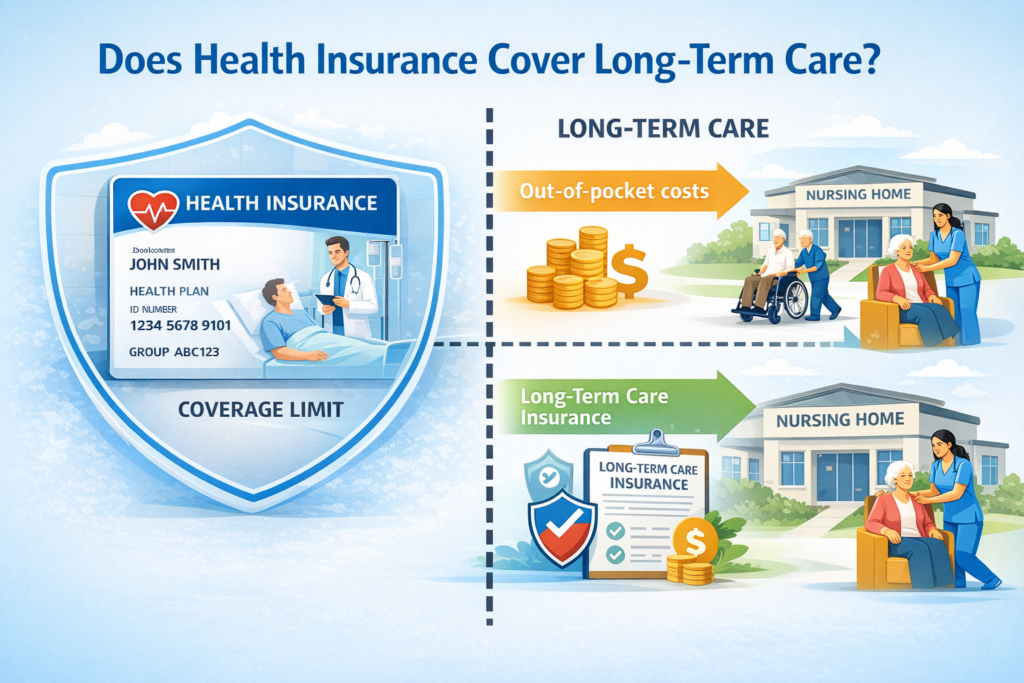
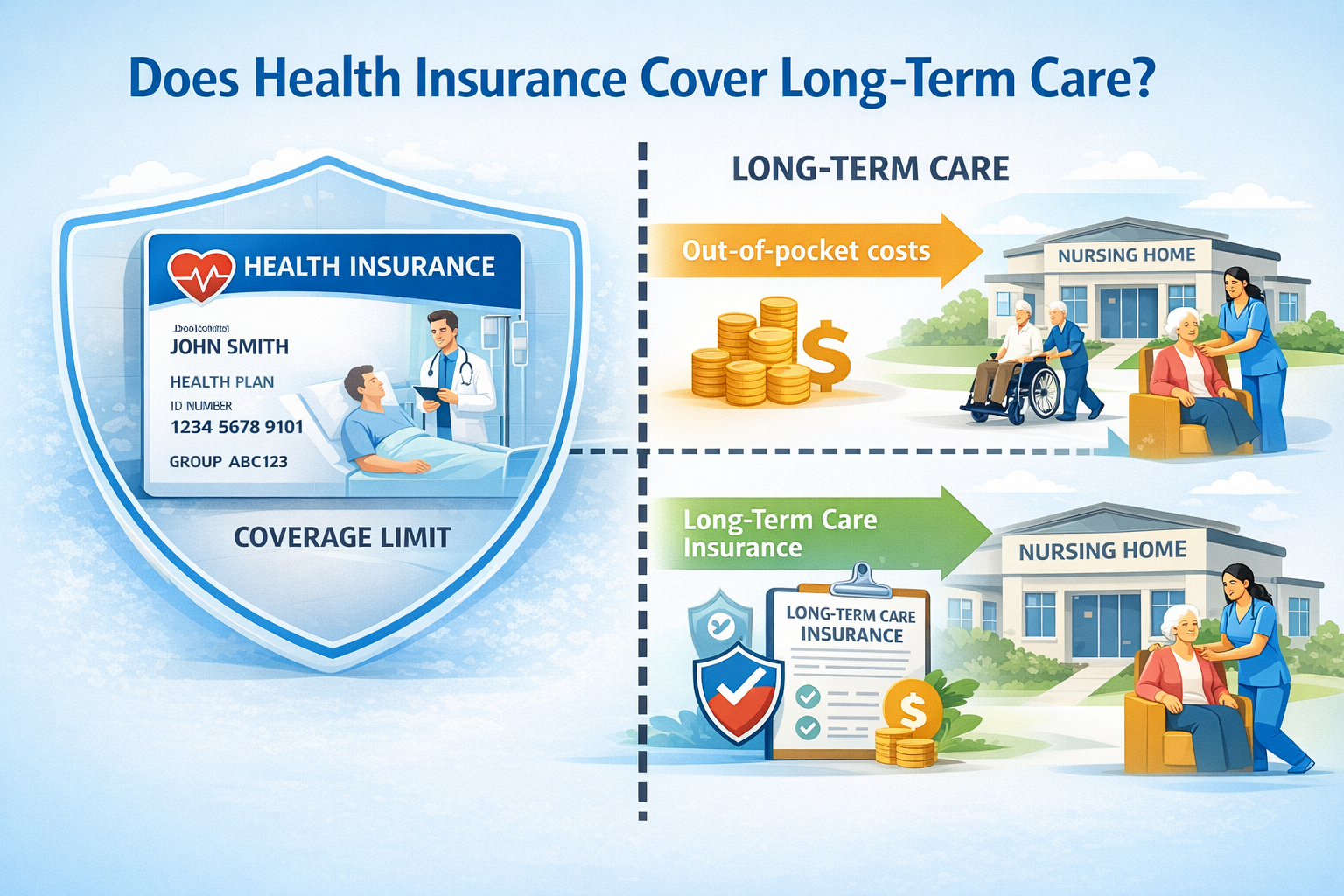
No. Health insurance generally does not cover long-term custodial care.
Health insurance pays for medical treatment and short-term recovery. Long-term care involves ongoing assistance with daily living, supervision, and safety.
Those two categories fall under different coverage systems.
What Health Insurance Covers vs What It Does Not
The confusion becomes clearer when services are compared directly.
Type of Service | Covered by Health Insurance |
Hospital treatment | Yes |
Surgery and medical procedures | Yes |
Diagnostic tests | Yes |
Short-term rehabilitation | Often |
Skilled nursing after illness | Sometimes |
Assisted living | No |
Long-term nursing home residence | No |
Help with daily activities | No |
The dividing line is simple:
Medical treatment may be covered.
Daily living assistance usually is not.
Why This Question Is So Common
People often believe health insurance will cover long-term care because insurance does cover the early stages of decline.
A typical sequence looks like this:
- A medical condition develops
- Hospital treatment is covered
- Rehabilitation services are approved
- Recovery slows
- Insurance coverage ends
From the patient’s perspective, nothing changed.
From the insurer’s perspective, the purpose of care changed.
Treatment ended. Ongoing assistance began.
That shift ends coverage.
What Health Insurance Is Designed to Do
Health insurance is structured around episodes of medical care.
It exists to pay for:
- diagnosis
- treatment
- stabilization
- recovery
These are temporary medical events.
Long-term care is different.
Long-term care involves continuous support, often lasting years rather than weeks.
Because of this structural difference, health insurance plans typically exclude long-term custodial care.
Skilled Medical Care vs Custodial Care
This distinction determines almost all long-term care coverage decisions.
Skilled Medical Care | Custodial Care |
Requires licensed professionals | May be provided by aides |
Treats or stabilizes conditions | Supports daily functioning |
Has clinical objectives | Ongoing assistance |
Usually temporary | Often long-term |
Health insurance generally covers skilled care.
Long-term care is primarily custodial care.
Once care crosses that boundary, insurance coverage usually ends.
Activities of Daily Living: The Center of Long-Term Care
Most long-term care revolves around assistance with Activities of Daily Living (ADLs).
These include:
- bathing
- dressing
- eating
- toileting
- mobility
- supervision for cognitive decline
Insurance plans typically do not cover ongoing help with these activities.
Even when these needs arise from illness or injury, the care itself is considered personal assistance rather than medical treatment.
The Nursing Home Confusion
Many families assume health insurance covers nursing homes.
This assumption often arises because insurance may cover short-term rehabilitation stays in skilled nursing facilities.
But the determining factor is not the building.
It is why the person is there.
Situation | Insurance Coverage |
Rehabilitation after illness | Sometimes covered |
Skilled nursing treatment | Sometimes covered |
Long-term residential care | Not covered |
The same facility may provide both types of care, but insurance only covers the medical phase.
Home Care: Another Area of Confusion
Health insurance may cover limited home health services, such as:
- intermittent skilled nursing visits
- therapy sessions
- medically necessary treatments at home
However, health insurance generally does not cover:
- full-time personal aides
- continuous supervision
- long-term home assistance
Once care becomes ongoing daily support rather than medical treatment, coverage ends again.
Assisted Living and Memory Care
Health insurance typically does not pay for:
- assisted living communities
- memory care facilities
- long-term residential supervision
These environments provide custodial support rather than medical treatment.
Residents receive help with daily activities, supervision, and safety monitoring—services outside the scope of traditional health insurance coverage.

Dementia and Cognitive Decline
Cognitive conditions often highlight insurance limitations most clearly.
People living with dementia may require:
- constant supervision
- reminders and cueing
- assistance with everyday activities
- safety monitoring
These services can continue for years.
Because they are not considered medical treatment, health insurance coverage for dementia-related care is usually limited.
Medical Necessity vs Care Necessity
Insurance denials often rely on a specific phrase:
“Services are no longer medically necessary.”
This phrase can feel confusing.
It does not mean care is unnecessary.
It simply means the services no longer qualify as medical treatment under insurance rules.
The person may still require care every day.
Only the coverage classification has changed.
What Happens After Health Insurance Stops Paying
When insurance coverage ends, families typically face three possibilities.
Stage | Typical Funding Source |
Hospital care | Health insurance |
Short-term rehabilitation | Health insurance |
Long-term assistance | Personal funds |
Late-stage support | Medicaid |
Medicaid may eventually cover long-term care for individuals who meet financial eligibility requirements.
However, qualifying usually requires significant asset spend-down and income limitations.
Health Insurance vs Medicare vs Long-Term Care Insurance
Another reason for confusion is that different programs cover different stages of care.
Program | Primary Purpose |
Health insurance | Medical treatment |
Medicare | Short-term skilled care |
Long-term care insurance | Custodial long-term care |
Understanding how these systems differ helps clarify why long-term care is often funded separately.
Readers exploring that broader planning question can see the full analysis here:
is-long-term-care-insurance-worth-it
Alternative planning approaches are discussed here:
alternatives-to-long-term-care-insurance
For readers trying to understand how insurance policies structure benefits, the following explanation may help:
long-term-care-insurance-benefit-period
Common misconceptions about long-term care insurance are addressed here:
which-long-term-care-insurance-statement-is-true
And this overview explains how long-term care insurance costs often change with age:
average-long-term-care-insurance-cost-by-age
The Statement That Is Actually True
After removing assumptions, one statement remains accurate:
Health insurance covers medical treatment—not long-term custodial care.
The difference lies in whether the services provided are clinical treatment or ongoing assistance with daily living.
That boundary explains nearly every long-term care coverage decision.
Why Understanding This Boundary Matters
Believing health insurance will cover long-term care often leads to:
- delayed planning
- underestimated costs
- rushed financial decisions
Understanding the boundary earlier allows families to prepare more realistically for future care needs.
Clarity reduces stress.
Where This Page Stops
This page does not recommend insurance products or financial strategies.
Its purpose is simpler.
It defines where health insurance responsibility ends so families do not plan around coverage that was never designed to exist.
In long-term care planning, understanding that boundary is often the most important first step.