
Hybrid Long-Term Care Insurance: What It Actually Solves, What It Doesn’t, and Where Risk Returns
Hybrid long-term care insurance is usually introduced as the calm alternative to a stressful decision. One policy. Two outcomes. No wasted money.
That framing works emotionally. It does not work structurally.
Hybrid long-term care insurance can reduce one specific fear—the fear of paying premiums and never using the coverage. What it does not do is remove the underlying risk that long-term care introduces. It reshapes that risk, concentrates it earlier, and caps it tightly.
This guide explains how hybrid long-term care insurance really functions, why it appeals to certain households, and where its protection ends long before many people expect.
What “Hybrid” Actually Means in Practice
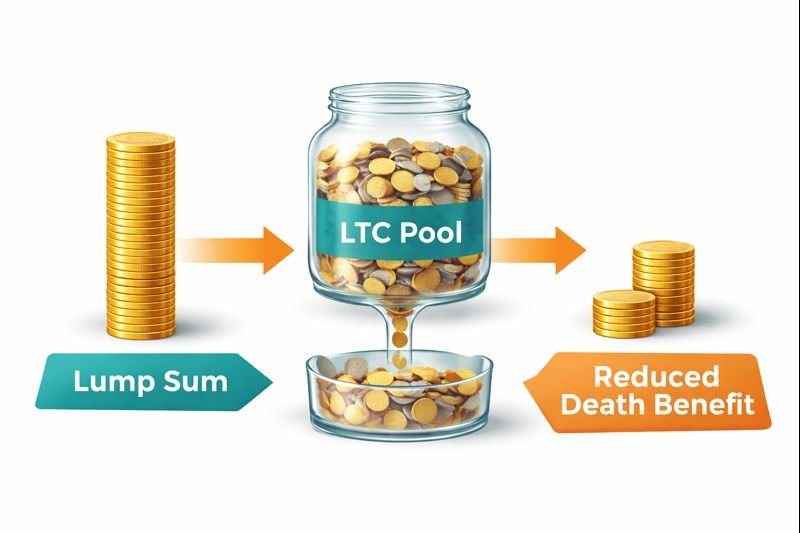
A hybrid long-term care policy is not a new category of insurance. It is a life insurance policy or annuity with a long-term care rider attached.
That structure matters because the long-term care benefit is not independent. It is tied directly to the value of the underlying contract.
If care is needed, benefits are drawn from a defined pool.
If care is not needed, a death benefit or annuity value remains.
Either way, the outcome is known. What is not known is whether the outcome will be enough.
The Promise SERPs Lean On — and Why It’s Incomplete
Search results heavily emphasize one line: “You don’t lose the money.”
That is technically true. It is also incomplete.
Hybrid policies remove regret risk, not care-duration risk. They ensure something happens. They do not ensure the benefit lasts as long as care does.
Most real-world care events are not short, binary events. They stretch. They escalate. They overlap.
Hybrid policies do not stretch with them.
How Hybrid Benefits Are Actually Consumed
Hybrid long-term care benefits are typically paid by:
Accelerating the death benefit, or
Accessing a pre-defined long-term care pool
Once that pool is exhausted, the policy stops contributing to care.
This is not a flaw. It is the design.
The problem is that many people implicitly assume hybrid benefits behave like open-ended coverage. They do not. They behave like a declining asset.
The Death Benefit Trade-Off Most People Miss
Every dollar used for care reduces what remains for heirs.
This matters in two ways:
The remaining death benefit may be much smaller than expected
Families relying on that future value may face surprise gaps
In long-duration care scenarios, the death benefit can be nearly or fully exhausted.
For households planning around legacy or spousal security, this trade-off needs to be explicit—not implied.

Inflation: Where Hybrid Policies Age Poorly
Inflation protection is the single most common SERP weakness in hybrid explanations.
Many hybrid policies:
Offer no inflation protection
Offer capped growth
Rely on static benefit pools
Over time, this creates a widening gap between:
What the policy pays
What care actually costs
This gap is invisible early. It becomes dominant later—precisely when alternatives are limited.
Hybrid certainty does not equal purchasing power certainty.
Liquidity and the Illusion of Flexibility
Most hybrid policies require:
A large lump-sum premium, or
A short, aggressive funding schedule
This removes the risk of future premium increases. It also locks capital into a structure that is difficult to unwind without loss.
Once committed:
Liquidity is reduced
Strategy changes are expensive
Exit options are limited
Hybrid policies reward confidence. They punish revision.
Underwriting Still Applies — Especially for Cognition
Hybrid policies are often described as easier to qualify for than traditional long-term care insurance.
That comparison is relative, not absolute.
Underwriting still evaluates:
Age
Health history
Cognitive indicators
People who delay often discover that hybrid eligibility narrows faster than expected—especially once memory concerns appear.
Hybrid does not mean guaranteed acceptance.
Cognitive Decline Is the Stress Test
Cognitive decline exposes the tightest boundary in hybrid policies.
Memory care:
Lasts longer
Escalates in cost
Requires sustained supervision
Hybrid benefit pools drain fastest here.
Once exhausted, the policy contributes nothing further to care—only whatever residual contract value remains.
This is where hybrid policies most often fall short of expectations.

Hybrid vs Traditional Long-Term Care Insurance (Boundary Only)
This is not a ranking.
Traditional long-term care insurance offers:
Higher leverage per premium dollar
Stronger inflation options
Ongoing premium uncertainty
Hybrid policies offer:
Predictable funding
No premium surprises
Lower long-term leverage
Neither removes risk. They concentrate it differently.
The choice is not about safety. It is about which risk you prefer to carry.
Hybrid vs State Programs (Boundary Context)
In states with public long-term care programs, hybrids are sometimes viewed as a replacement.
They are not.
State programs reduce early exposure.
Hybrid policies cap total exposure.
Neither addresses long-duration care on its own.
Layering is the real issue—not substitution.
Where Hybrid Policies Tend to Work Best
Hybrid long-term care insurance tends to work best when:
Assets are clearly surplus
Liquidity needs are low
Premium predictability is a priority
Long-term care risk is acknowledged as capped, not eliminated
In these cases, hybrids can reduce anxiety and simplify planning.
Where Hybrid Policies Commonly Fail
Hybrid policies fail most often when:
They are treated as comprehensive coverage
Inflation risk is minimized
Care duration is underestimated
Family caregiving is assumed
Capital lock-in is ignored
The failure is not dramatic. It is gradual—and usually irreversible.
The Boundary That Matters
Here is the clean boundary SERPs reward most clearly when stated plainly:
Hybrid long-term care insurance removes regret. It does not remove long-term care risk.
It guarantees an outcome. It does not guarantee adequacy.
Treating it as a complete solution is the mistake.
Who Should Pause Before Choosing a Hybrid
Hybrid policies deserve extra scrutiny if:
Liquidity may be needed later
Legacy planning matters
Inflation protection is limited
Cognitive decline risk is high
Flexibility is valued
The appeal is emotional certainty.
The risk is structural rigidity.
Where This Page Stops
This page does not recommend or reject hybrid long-term care insurance.
Its role is narrower:
For readers deciding whether hybrid coverage truly fits—or whether another approach makes more sense—the full decision framework brings insurance, hybrids, and alternatives together in one place.
to make the capital, duration, and irreversibility boundaries visible before decisions lock in.
That clarity—not guarantees—is what protects choice later.