
Long-Term Care Insurance Partnership Program: What It Protects, When It Helps, and Where the Limits Appear
The long-term care insurance Partnership Program is often described with a simple phrase: asset protection.
That description is directionally accurate — but incomplete.
The program does not eliminate care costs.
It does not prevent assets from being used during years of care.
And it does not replace long-term care insurance itself.
Instead, the Partnership Program works at a specific point in the long-term care timeline: Medicaid eligibility.
Understanding that timing is the key to understanding what the program truly does — and what it does not.
Quick Explanation: What the Partnership Program Does
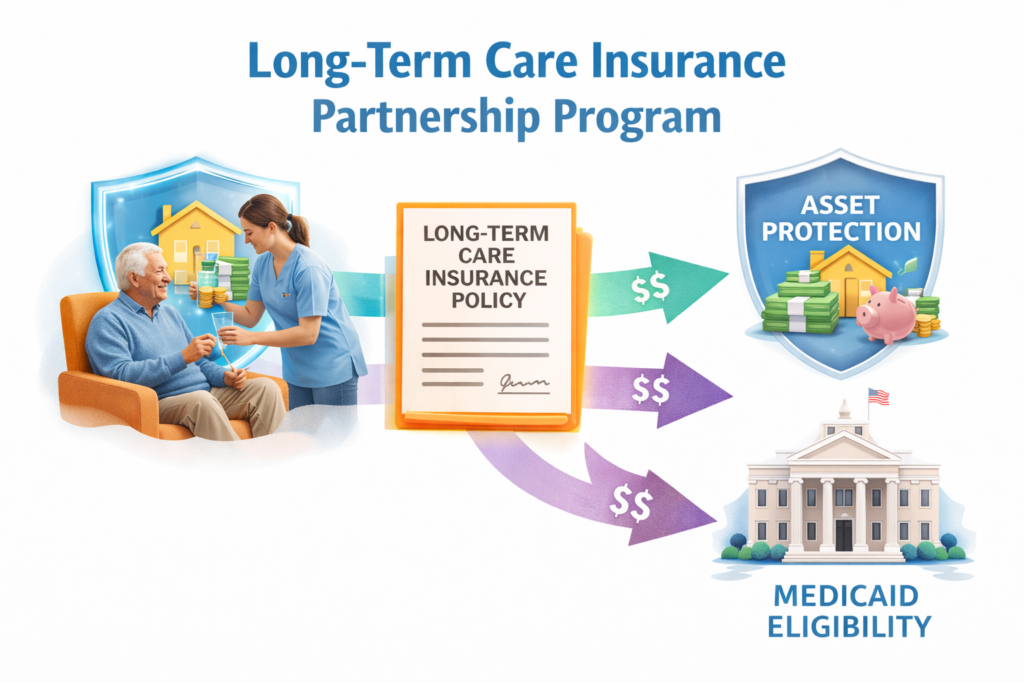
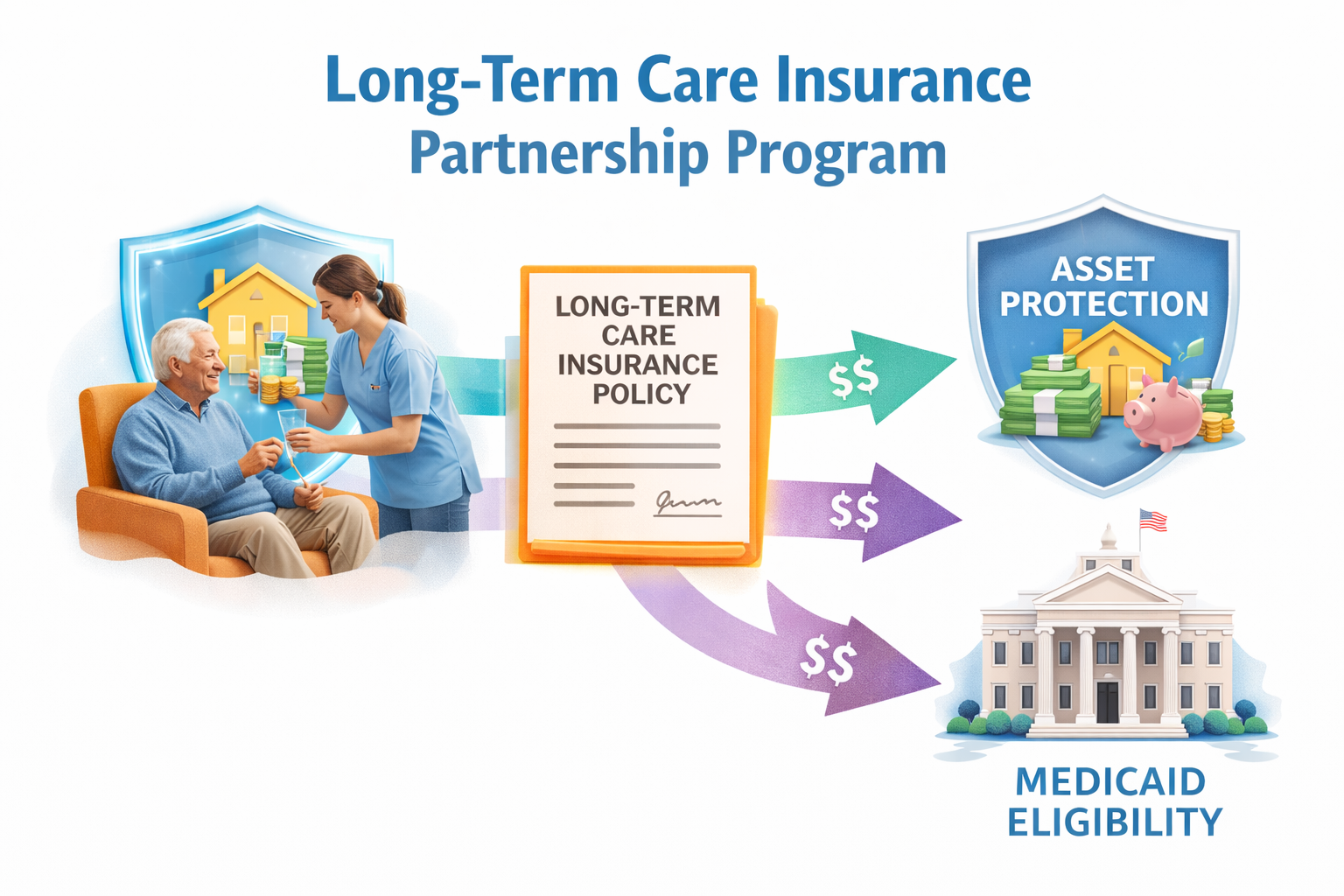
The Long-Term Care Insurance Partnership Program allows certain assets to be disregarded for Medicaid eligibility if a qualifying long-term care insurance policy has already paid benefits.
In simple terms:
If a qualified policy pays benefits, Medicaid may allow the policyholder to retain assets equal to the amount the insurance policy paid.
The program connects private long-term care insurance with Medicaid eligibility rules rather than replacing them.
For the broader question of whether LTC insurance makes sense in the first place, see
is-long-term-care-insurance-worth-it
What the Partnership Program Actually Is
The Partnership Program is a public–private coordination system between private long-term care insurance policies and Medicaid.
The basic sequence works like this:
- A person buys a Partnership-qualified long-term care insurance policy.
- The policy pays benefits when care is needed.
- If those benefits are eventually exhausted and Medicaid eligibility is evaluated, assets equal to the benefits paid may be disregarded.
This is not asset protection at the beginning of care.
It is asset disregard during Medicaid eligibility evaluation.
That distinction is where most misunderstandings originate.
Example: How Dollar-for-Dollar Asset Protection Works
A numerical example makes the concept clearer.
Example scenario:
Policy benefits paid: $200,000
If the individual later applies for Medicaid:
Medicaid may disregard $200,000 of countable assets.
This means the person may qualify for Medicaid while retaining those assets rather than spending them down entirely.
However:
- care costs still occurred earlier
- insurance benefits still funded the initial years of care
- other Medicaid eligibility rules still apply
The Partnership Program modifies asset treatment, not the cost of care itself.
What Makes a Policy Partnership-Qualified
Not every long-term care insurance policy qualifies for Partnership status.
To qualify, a policy must generally:
- be federally tax-qualified long-term care insurance
- be issued by an insurer participating in the state Partnership program
- meet state Partnership certification requirements
- include required inflation protection based on the buyer’s age
Typical inflation requirements:
- Under age 61 → compound inflation protection required
- Age 61–75 → some inflation protection required
- Age 76+ → inflation protection may not be required
These rules exist to ensure that Partnership policies maintain meaningful value over time.
What the Partnership Program Can — and Cannot — Do
What It Can Do | What It Cannot Do |
Allow certain assets to be disregarded at Medicaid eligibility | Prevent care costs during insurance years |
Coordinate private insurance with Medicaid rules | Guarantee estate preservation |
Encourage early long-term care planning | Eliminate Medicaid income rules |
Provide asset protection tied to policy benefits | Replace long-term care insurance coverage |
Understanding this difference prevents most planning mistakes.
The Timing Gap Most People Miss
Long-term care costs usually begin years before Medicaid eligibility becomes relevant.
During active care:
- insurance benefits pay first
- out-of-pocket expenses often fill gaps
- assets may be used to cover remaining costs
By the time Medicaid becomes relevant, a meaningful portion of assets may already have been used.
The Partnership Program protects remaining assets, not the entire financial position that existed before care began.
Estate Recovery and Partnership Policies
Medicaid programs normally attempt to recover certain long-term care costs from an individual’s estate after death.
Partnership-qualified policies can reduce this exposure.
Assets equal to the amount of insurance benefits paid may also be protected from estate recovery in many states.
However, the exact outcome still depends on:
- state-specific Medicaid rules
- the amount of benefits paid
- the structure of the remaining estate
The program reduces potential recovery exposure but does not eliminate Medicaid estate recovery entirely.

Spousal Financial Impact
Medicaid already contains rules intended to protect a spouse who remains living at home.
These are known as spousal impoverishment protections.
The Partnership Program may expand the amount of assets that can be retained under those rules.
However, the program does not eliminate:
- income contribution rules
- Medicaid eligibility requirements
- financial adjustments within the household
Even with asset protection, household cash flow can change significantly during long-term care.
Care Duration: The Silent Variable
Long-term care often lasts longer than expected.
Conditions such as Alzheimer’s disease or other cognitive impairments may require care for many years.
In those cases:
- insurance benefits may exhaust earlier than expected
- care costs continue
- Medicaid eligibility becomes increasingly relevant
The longer the care timeline, the more important the original insurance design becomes.
For a broader comparison of long-term care strategies see
long-term-care-insurance-pros-and-cons
State Reciprocity and Moving Risk
Partnership programs operate at the state level.
Many states participate in reciprocity agreements recognizing policies issued in other Partnership states.
However, assumptions can become complicated if someone:
- purchases a policy in one state
- relocates later in retirement
- eventually applies for Medicaid in another state
Because Medicaid is state-administered, planning assumptions should always consider location.
A state example of how programs differ can be seen here:
long-term-care-insurance-washington-state
Partnership Policy vs Standard Long-Term Care Insurance
Feature | Standard LTC Insurance | Partnership-Qualified Policy |
Pays long-term care costs | Yes | Yes |
Asset protection at Medicaid eligibility | No | Yes |
Inflation protection requirements | Optional | Age-based requirements |
Medicaid coordination | None | Built into policy design |
The insurance coverage may appear similar, but the Medicaid interaction changes the planning outcome.
Who the Partnership Program Often Fits Best
The program may be useful for people who:
- want private insurance coverage first
- prefer the possibility of asset protection if Medicaid becomes necessary
- purchase qualified long-term care insurance earlier in life
- want a layered long-term care funding strategy
Situations Where Extra Caution Is Warranted
Additional scrutiny may be appropriate if:
- estate preservation is the primary goal
- relocation between states is likely
- the household expects insurance alone to cover long-duration care
- hybrid or rider-based products are being used instead of qualified policies
Alternative planning strategies can be explored here:
alternatives-to-long-term-care-insurance
The Boundary That Matters
The Partnership Program protects assets when Medicaid eligibility is evaluated.
It does not eliminate care costs.
It does not prevent insurance benefits from exhausting.
And it does not replace long-term care planning.
Used correctly, it becomes one layer of protection within a broader strategy rather than a complete solution.