
Long-Term Care Insurance: Pros and Cons (Without a Conclusion)
Most articles about long-term care insurance try to resolve the decision for you. Some lean toward reassurance (“this protects your family”). Others lean toward rejection (“it’s overpriced and unnecessary”).
Both approaches simplify a decision that is neither simple nor universal.
This page does something narrower.
It lays out where long-term care insurance can genuinely help, where it often fails expectations, and why both realities frequently exist at the same time. There is no final recommendation here. That is not an omission—it is deliberate.
If you are looking for certainty, this page will feel incomplete.
If you are trying to remove blind spots before making a long-term financial decision, this is where clarity often begins.
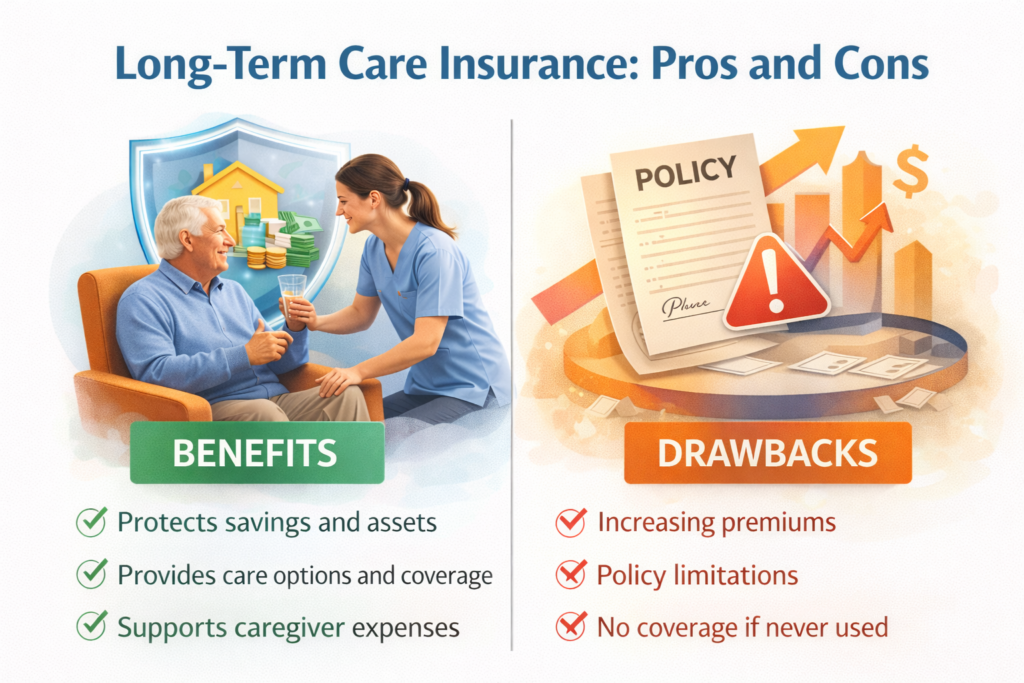
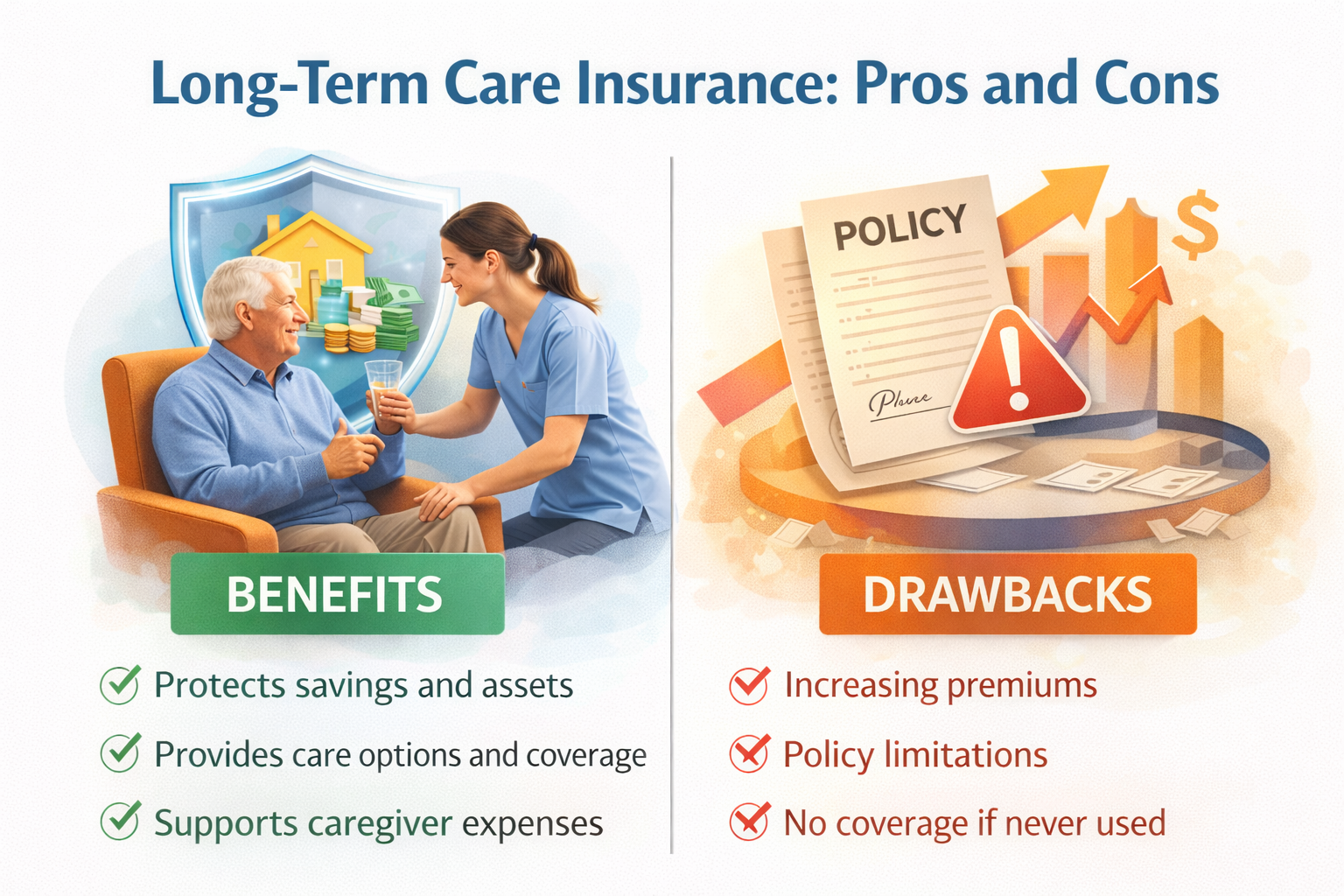
Quick Snapshot: Pros vs Cons
Before going deeper, the trade-offs can be summarized simply.
Potential Advantages | Common Limitations |
Can slow asset depletion during extended care | Premiums can increase over time |
Can reduce caregiving pressure on family | Coverage is capped |
Can support home-based care earlier | You may never use the policy |
Can delay reliance on Medicaid | Underwriting excludes some buyers |
Creates structure for planning | Policies require oversight |
This table is not a verdict.
It simply shows why people evaluating long-term care insurance often see both benefits and drawbacks simultaneously.
The Boundary Most People Misunderstand
Long-term care insurance does not cover medical treatment.
It primarily covers custodial care—assistance with daily functioning when someone can no longer live independently.
That usually means help with Activities of Daily Living (ADLs):
- bathing
- dressing
- eating
- toileting
- transferring
- supervision for cognitive decline
This distinction matters because Medicare largely pays for medical services, not extended custodial care. Medicaid may cover long-term care, but typically only after strict financial eligibility thresholds are met.
Private insurance sits between those systems. It does not replace them.
If you want a deeper breakdown of how private policies fit within the broader planning landscape, see
is-long-term-care-insurance-worth-it.
What Long-Term Care Insurance Is Actually Designed to Do
At its core, long-term care insurance attempts to convert an unpredictable care risk into a defined benefit pool funded through premiums paid in advance.
In practical terms, it attempts to change the financial shape of a potential care event.
For example, if someone requires four years of home-based care, policy benefits may offset a portion of those expenses and slow how quickly personal savings are consumed. If the benefit pool is exhausted earlier than expected, remaining costs return to the household.
Insurance changes the timing and scale of financial pressure, not the existence of that pressure.
Understanding this boundary is central to evaluating the pros and cons of long-term care insurance.
The Pros — Where Long-Term Care Insurance Can Help
1. It Can Slow Asset Depletion During Extended Care
The largest financial risk in aging is rarely a short hospital stay. It is long-duration custodial care, particularly when cognitive decline is involved.
Insurance benefits can:
- reduce the speed at which savings are drawn down
- delay forced liquidation of investments
- preserve flexibility during early care decisions
Where this breaks:
If care is brief or never required, lifetime premiums may exceed the benefit received.
2. It Can Change Care Logistics Inside Families
Without resources, caregiving often falls unevenly across family members.
Insurance benefits can:
- enable paid home care services
- reduce dependence on unpaid caregiving
- create alternatives when family members live far apart
This shifts logistics more than emotions.
Where this breaks:
Financial resources do not eliminate caregiver burnout or relationship strain.
3. It Preserves Choice Earlier—Not Indefinitely
Without private funding, families often face care decisions only after financial resources have already narrowed.
Insurance benefits can:
- support home care longer
- delay reliance on Medicaid
- provide flexibility when transitioning between care settings
However, that flexibility lasts only while benefits remain available.
Once benefits are exhausted, financial constraints return quickly.
For a comparison of other planning approaches households sometimes explore, see
alternatives-to-long-term-care-insurance.
4. It Can Protect a Healthy Spouse
In couples, long-term care needs are rarely symmetrical.
One spouse may require extended care while the other remains independent.
Insurance can help:
- reduce financial disruption to the household
- preserve income for the non-caregiving spouse
- prevent rapid depletion of joint assets
Where this breaks:
If premiums create financial strain earlier in retirement, protection later in life may come at a high present-day cost.
5. It Provides Structure for Planning Conversations
Some households prefer defined planning frameworks.
A policy creates:
- clear eligibility triggers
- defined benefit limits
- a structured reference point for discussing care scenarios
This structure alone can reduce uncertainty for certain families.
Where this breaks:
Premium adjustments, benefit caps, and claims processes can weaken that predictability over time.
For couples evaluating policies together, the structure can also become more complex when features like shared benefits are involved. You can see how those arrangements work in

The Cons — Where Expectations Commonly Break Down
1. Premiums Are Adjustable, Not Permanently Fixed
This is one of the most common sources of frustration among policyholders.
Even policies labeled “guaranteed renewable” can experience premium increases with regulatory approval.
Guaranteed renewable means the insurer cannot cancel your policy individually for using benefits. It does not guarantee premiums will never rise.
If increases occur later in life, policyholders may face difficult decisions about maintaining coverage.
2. You Can Pay for Decades and Never Use It
Unlike life insurance, long-term care insurance has no guaranteed payout event.
Many people:
- die without needing long-term care
- require only short-term assistance
- qualify for benefits too late to justify lifetime premiums
This is not a flaw in the product. It is the cost of transferring risk.
3. Claims Depend on Definitions, Not Perceived Need
Policies pay based on contractual definitions.
Typical triggers include documented inability to perform Activities of Daily Living or cognitive impairment.
Common friction points include:
- elimination periods
- documentation requirements
- care-setting eligibility
- provider approval rules
Understanding how those triggers work is essential. A deeper explanation of common policy rules appears in
which-long-term-care-insurance-statement-is-true.
4. Benefits Rarely Match Total Care Costs
Policies typically include daily or monthly benefit limits.
Even with inflation riders, gaps can appear when:
- dementia care escalates
- regional care costs rise faster than expected
- care duration extends longer than the policy period
Insurance usually offsets expenses rather than covering them completely.
5. Medical Underwriting Excludes Many Buyers
Long-term care insurance is easiest to obtain before it feels relevant.
Common disqualifiers include:
- cognitive impairment
- chronic conditions
- advanced age
Many families begin exploring policies only after eligibility has already passed.
6. Policies Require Ongoing Oversight
Long-term care insurance is not a passive product.
Over time, policies may require:
- reviewing inflation riders
- evaluating premium adjustments
- understanding benefit periods
- navigating claim requirements
For example, understanding how long coverage actually lasts requires examining the benefit period, which is explained in
long-term-care-insurance-benefit-period.
Orientation Table (Not a Verdict)
Dimension | Where It Helps | Where It Breaks |
Financial risk | Extended multi-year care | Short or no care |
Family impact | Reduces logistical burden | Emotional strain remains |
Choice | Delays Medicaid reliance | Temporary leverage |
Predictability | Defined structure | Premium uncertainty |
Coverage | Partial cost offset | Real-world gaps |
This table exists to remove illusions, not to persuade.
Common Misunderstandings That Skew Decisions
“If I buy a policy, I’m fully covered.”
Coverage is conditional and capped.
“Premiums are fixed forever.”
They can increase over time.
“Insurance solves long-term care planning.”
It addresses only one part of the system.
“Not buying insurance is irresponsible.”
Responsibility depends on assets, family support, and alternatives.
Where This Page Stops
Long-term care insurance is not a universal solution.
It is a financial tool designed to manage a specific risk. Like most tools, it can help in some situations and create complications in others.
Pros and cons exist because long-term care planning involves overlapping factors: health, family capacity, financial resources, and uncertainty about how care needs may unfold over time.
This page stops before resolving the decision.