
Shared Care Long-Term Care Insurance: What Couples Gain, What They Share, and What They Still Face Alone
Shared care long-term care insurance is often presented as a cooperative safety net for couples.
Two people.
Two policies.
One shared layer of flexibility.
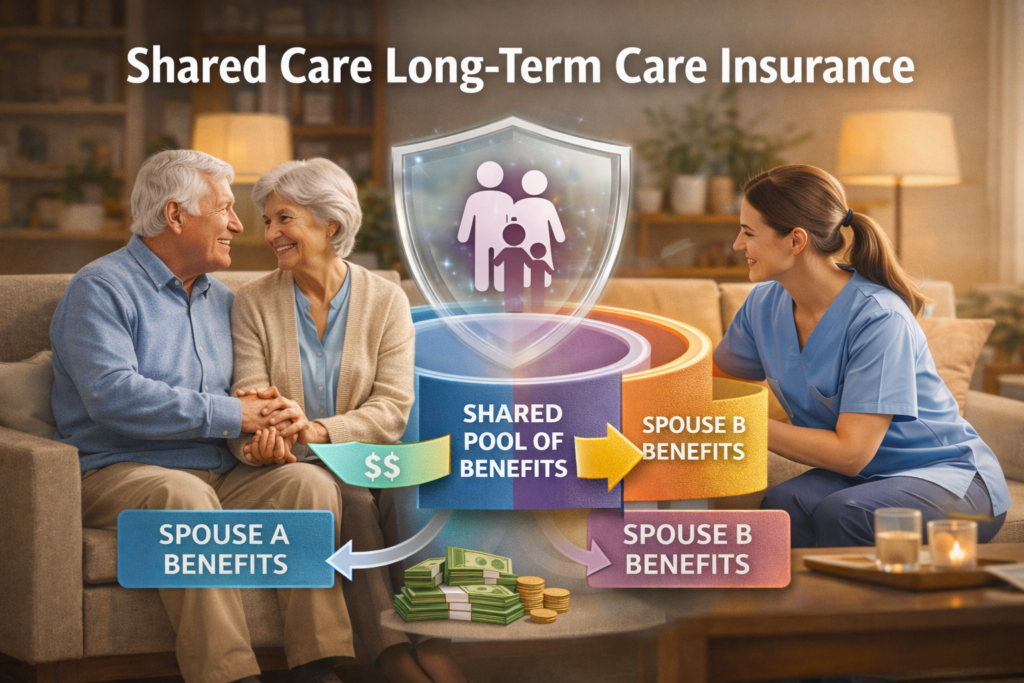
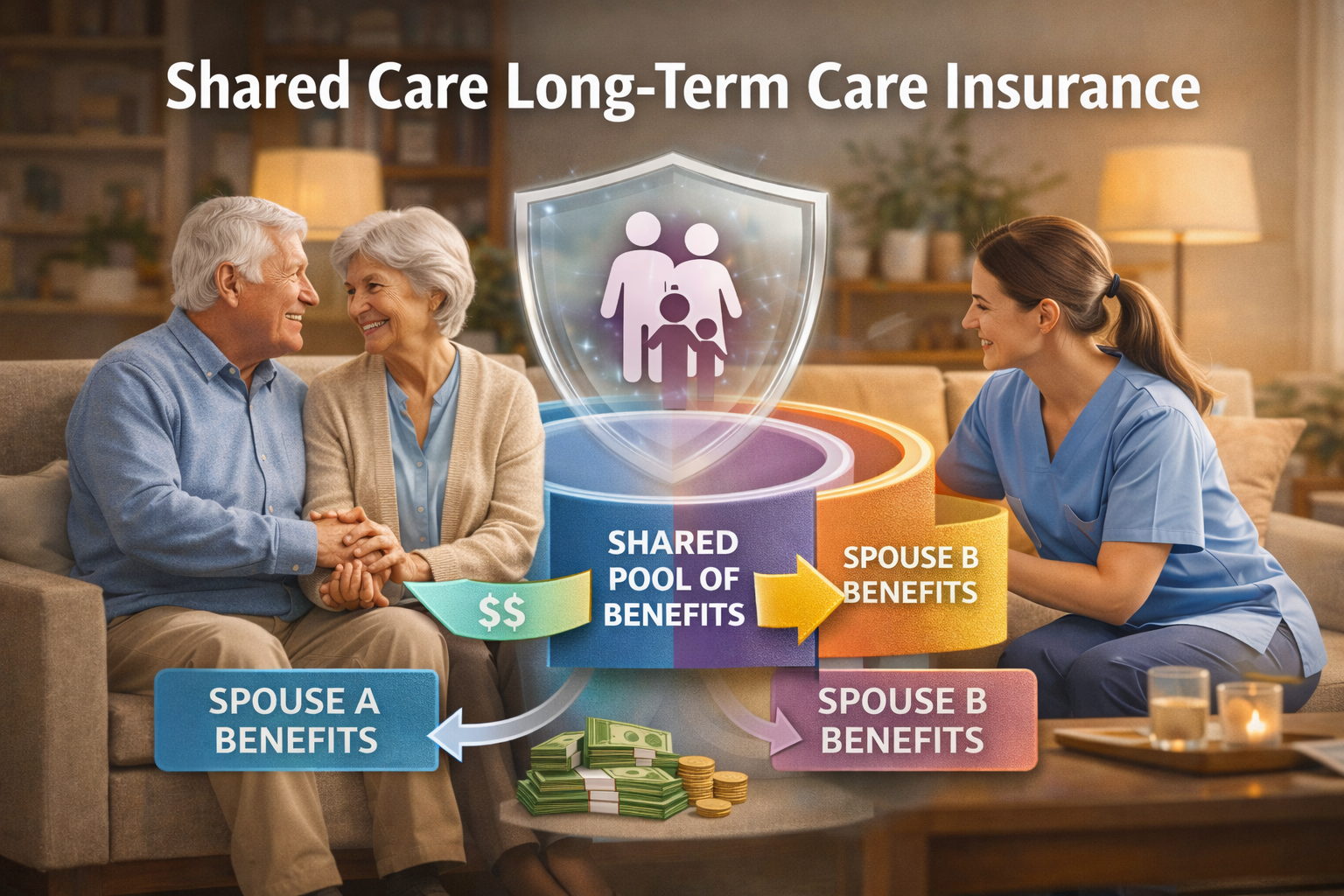
The idea is straightforward: if one spouse never uses their long-term care benefits, the other spouse may be able to access those unused benefits later.
That framing is broadly accurate. But it can also lead couples to assume the rider creates far more protection than it actually does.
Shared care does not double insurance coverage.
It does not remove long-term care risk for couples.
And it does not prevent both spouses from eventually needing care.
Instead, shared care allows unused benefits from one policy to be accessed by the other policyholder under certain circumstances.
Understanding that flexibility — and where it stops — is what determines whether shared care meaningfully strengthens a long-term care strategy.
For a broader evaluation of whether long-term care insurance makes sense overall, see
is-long-term-care-insurance-worth-it
What Shared Care Long-Term Care Insurance Actually Is
Shared care is an optional rider that links two individual long-term care insurance policies, typically issued to spouses or partners.
Each person still owns their own policy.
Each policy still includes its own:
- benefit amount
• benefit period
• elimination period
• eligibility requirements
The shared care rider simply allows unused benefits from one policy to be accessed by the other policyholder after their own policy benefits are exhausted.
This means benefits are reallocated between policies, not duplicated.
The total amount of insurance coverage available to the couple does not increase.
Why Insurers Introduced Shared Care Riders
Shared care riders emerged after insurers observed a recurring pattern among couples with long-term care insurance.
In many households:
- one spouse eventually required extended care
• the other spouse never used their policy benefits
This created situations where one policy exhausted its coverage while the other policy remained largely unused.
Shared care riders were designed to reduce that imbalance by allowing unused benefits to shift between partners.
The rider does not increase the total insurance pool, but it allows that pool to be used more flexibly when care needs between spouses turn out to be uneven.
Example: How Shared Care Benefits Work
A numerical example illustrates the mechanics clearly.
Imagine a couple purchases identical long-term care insurance policies.
Each policy provides:
- $150 daily benefit
• 3-year benefit period
• shared care rider attached
Each spouse therefore has a total benefit pool of approximately:
$150 × 365 × 3 = $164,250
If Spouse A eventually exhausts their own policy benefits but still requires care, the shared care rider may allow them to access unused benefits from Spouse B’s policy.
If Spouse A uses an additional $80,000 from that shared pool:
- Spouse A receives extended coverage
• Spouse B’s remaining future coverage declines by $80,000
For example, if Spouse A required care for five years instead of the original three-year benefit period, the shared care rider could extend coverage using Spouse B’s unused benefits.
That extension would reduce the protection available to Spouse B if care becomes necessary later.
Shared care therefore creates flexibility, but the combined insurance pool still declines.

How Shared Care Policies Are Typically Designed
Most insurers structure shared care riders around two similar or identical policies issued together.
Common policy design elements include:
- identical benefit periods
• similar daily benefit levels
• inflation protection selected individually
• separate elimination periods for each spouse
The rider generally activates only after one spouse exhausts their own policy benefits.
Until that point, both policies function independently.
How Shared Care Riders Differ Between Insurers
Shared care riders are not identical across all long-term care insurance policies.
Depending on the insurer, the rider may include:
- a shared extension pool equal to the original benefit period
• limits on how much coverage can be transferred between spouses
• requirements that both policies maintain similar benefit structures
• restrictions on when shared benefits become available
Because these rules vary by carrier, reviewing the exact rider language is essential before assuming how much coverage can actually be shared.
Does the Shared Care Rider Increase Premiums?
Adding a shared care rider typically increases policy premiums modestly.
The increase reflects the possibility that one spouse could eventually access both policies’ benefit pools.
However, the rider is often less expensive than extending the benefit period on both policies individually.
For many couples the rider functions as a cost-efficient way to add flexibility rather than increasing the total amount of insurance purchased.
What Shared Care Long-Term Care Insurance Does Not Change
Even with the rider, several realities remain unchanged.
Shared Care Can Improve | Shared Care Cannot Change |
Allows unused benefits to shift between spouses | Total insurance coverage remains finite |
Provides flexibility if one spouse needs more care | Both spouses may still require long-term care |
Reduces risk of unused benefits | Long-duration care risk still exists |
Extends coverage for one partner | Out-of-pocket exposure may still occur |
Shared care improves how insurance benefits are allocated, but it does not increase the total coverage available.
Typical Long-Term Care Claim Timelines
Long-term care claims for couples rarely begin at the same time.
A common pattern observed by insurers is:
- one spouse begins needing assistance first
• the second spouse continues living independently for several years
• care needs for the second spouse may appear later in retirement
Shared care riders were designed to provide flexibility in these uneven timelines.
However, if both spouses eventually require extended care, the combined benefit pool can still decline faster than expected.
Cognitive Decline and Long Care Duration
Conditions such as Alzheimer’s disease and other forms of dementia can extend care timelines significantly.
These conditions often require:
- long-term supervision
• residential care
• escalating assistance over multiple years
If one spouse uses shared benefits during an extended cognitive decline timeline, the second spouse’s remaining coverage may be reduced.
Shared care can still help in these situations, but benefit duration remains one of the most important design decisions.
For deeper explanation of coverage duration planning see
long-term-care-insurance-benefit-period
Shared Care vs Separate Policies
Couples sometimes compare shared care with purchasing two separate policies that are not linked.
Feature | Shared Care Policies | Separate Policies |
Flexibility between spouses | Higher | Lower |
Cross-depletion risk | Yes | No |
Benefit efficiency | Potentially higher | Potentially lower |
Simplicity | Moderate | Higher |
Neither approach eliminates long-term care risk.
They simply distribute that risk differently.
Couples considering different policy structures may also review
hybrid-long-term-care-insurance
Planning Takeaway for Couples
Shared care riders do not increase the total amount of long-term care insurance a couple owns.
What they provide is flexibility.
For couples whose care needs turn out to be uneven, that flexibility can extend coverage for the spouse who requires more care.
For couples who eventually require care at similar times, however, the combined benefit pool can still decline more quickly than expected.
Understanding shared care as benefit flexibility rather than additional protection helps couples evaluate the rider more realistically.
Shared care riders extend private insurance coverage, but they do not eliminate the possibility that individuals may eve