
Which Long-Term Care Insurance Statement Is True? The Few That Hold Up—and Why Most Don’t
People who search “which long-term care insurance statement is true” are usually reacting to conflicting information.
They encounter confident claims like:
- Medicare will help with long-term care
• Long-term care insurance protects assets
• Family members can handle most care
• Inflation riders solve future cost increases
Each of these statements contains some element of truth.
But long-term care planning is unusual: statements that sound correct early often break down once real care timelines unfold.
This guide isolates the statements that remain true under realistic conditions—and explains why many widely repeated claims fail once duration, cost, and caregiving realities are considered.
Quick Answer
The statement that is consistently true about long-term care insurance is:
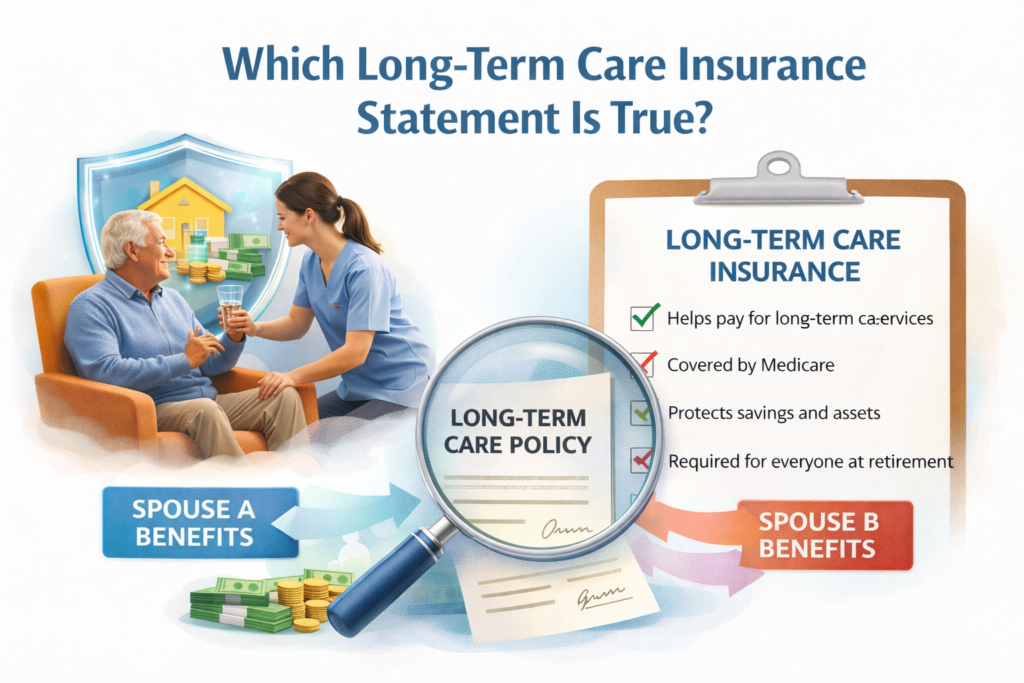
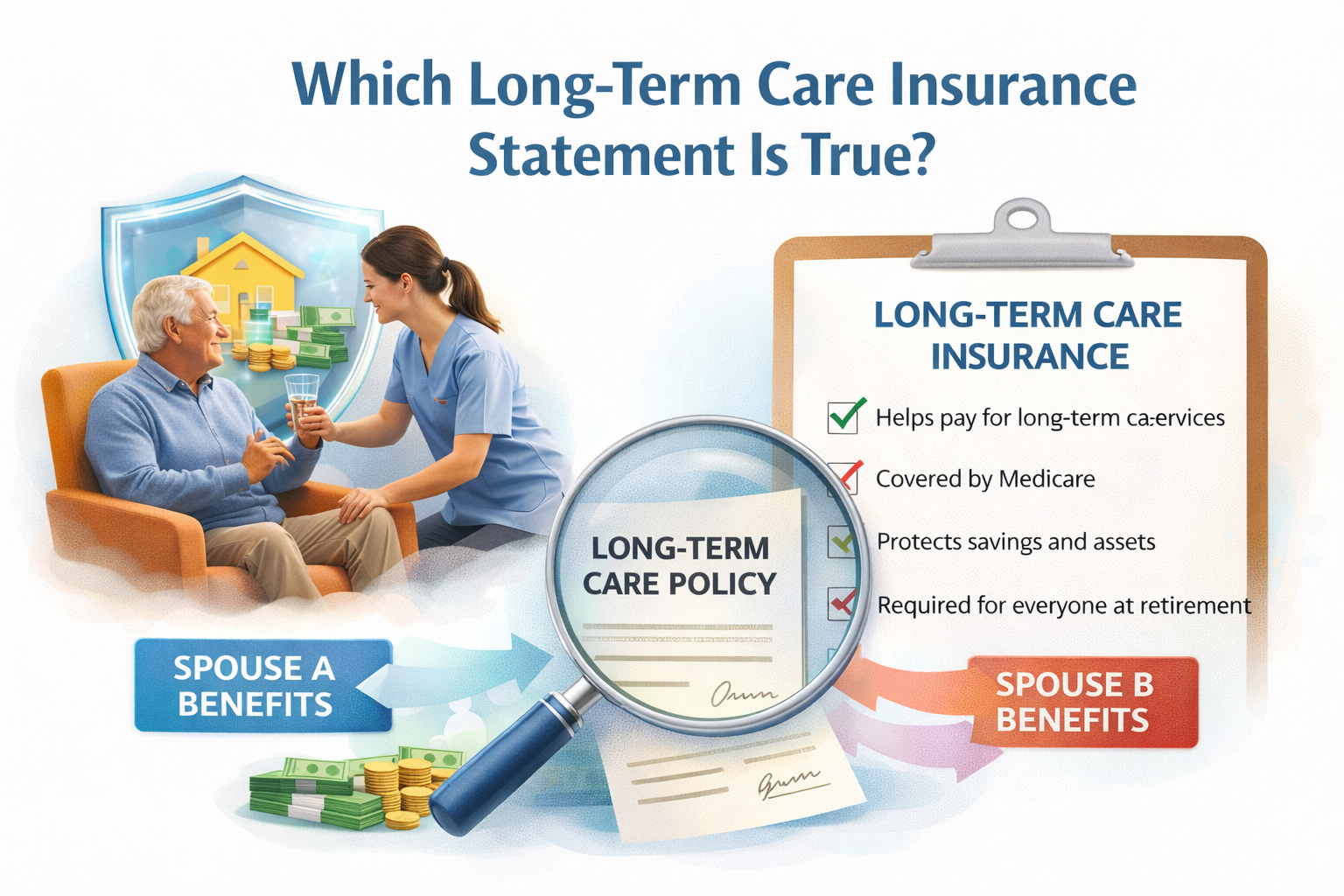
Long-term care insurance primarily covers custodial care, meaning assistance with daily living activities rather than medical treatment.
This is the core function of long-term care insurance policies and the reason they exist separately from traditional health insurance.
Why This Question Appears in Insurance Exams
The question “which long-term care insurance statement is true” appears frequently in insurance licensing exams and training materials.
The goal is to test whether candidates understand a key distinction:
Medical care and custodial care are not the same.
Traditional health insurance focuses on medical treatment, while long-term care insurance is designed to pay for assistance when individuals can no longer perform daily activities independently.
Understanding that difference is the foundation of long-term care planning.
Quick Reality Check: True vs False Statements
Statement | True or False | Key Reason |
Long-term care insurance covers custodial care | True | Policies are designed to pay for assistance with daily living activities |
Medicare pays for long-term care | Mostly false | Medicare only covers limited short-term skilled care |
Long-term care insurance protects all assets | Misleading | Policies have benefit limits |
Long-term care insurance covers all care costs | False | Coverage is capped by policy limits |
Inflation riders guarantee future coverage adequacy | Partially true | Riders help but cannot guarantee cost coverage |
This table reflects how common statements perform once real care timelines are considered.
Statement 1
“Long-Term Care Insurance Primarily Covers Custodial Care”
True in most standard policy structures.
Long-term care insurance exists primarily to cover custodial care, meaning assistance with everyday activities rather than medical treatment.
Typical triggers include difficulty performing activities of daily living (ADLs) such as:
- bathing
• dressing
• eating
• toileting
• mobility
• cognitive supervision
For example, a person who can no longer dress or bathe independently may qualify for benefits even if they are not hospitalized or receiving medical treatment.
This boundary is fundamental. Long-term care insurance does not replace health insurance.
It covers functional assistance rather than medical procedures.
Statement 2
“Medicare Pays for Long-Term Care”
Mostly false.
Medicare may cover short periods of skilled nursing care or rehabilitation following hospitalization.
However, Medicare does not cover extended custodial care.
Once a person needs ongoing assistance with daily activities rather than medical treatment, Medicare coverage generally stops.
This misunderstanding persists because early stages of care may include medical treatment before transitioning into long-term custodial support.
Statement 3
“Long-Term Care Insurance Protects Your Assets”
Conditionally true — but commonly overstated.
Long-term care insurance can reduce financial exposure by covering part of long-term care costs.
However, asset protection depends on several factors:
- policy benefit limits
• duration of care
• inflation protection
• total coverage pool
If care lasts longer than the policy’s benefit period, additional costs may still come from personal assets.
Insurance transfers risk, but it does not eliminate it.
Statement 4
“Most People Never Use Long-Term Care Insurance”
Misleading and largely irrelevant to planning.
Long-term care planning focuses less on averages and more on severity risk.
A short care event may be manageable financially.
A long care event—especially involving cognitive decline—can create substantial financial strain.
Long-term care insurance exists primarily to address those high-impact scenarios.

Statement 5
“Long-Term Care Insurance Covers All Long-Term Care Costs”
False.
Every long-term care insurance policy has limits.
These limits may include:
- daily or monthly benefit caps
• total benefit pools
• benefit period limits
Once those limits are reached, coverage stops—even if care continues.
One of the most common planning mistakes is assuming long-term care insurance functions like unlimited coverage.
Statement 6
“Inflation Protection Solves Future Cost Increases”
Partially true.
Inflation riders help benefits grow over time.
However, they cannot guarantee full protection against future care costs.
Care costs can rise faster than projected inflation, especially in specialized care settings such as memory care facilities.
Inflation protection improves purchasing power but does not remove uncertainty.
Statement 7
“If the Policy Is Never Used, the Money Is Wasted”
Emotionally understandable but financially incorrect.
Insurance is not an investment.
It is a risk-transfer tool.
Long-term care insurance helps stabilize financial and family risk if extended care becomes necessary.
If the risk never occurs, the insurance still served its purpose.
Hybrid policy structures exist largely because many consumers struggle with this perception.
Statement 8
“Long-Term Care Insurance Only Pays for Nursing Homes”
False.
Most modern policies cover multiple care settings, including:
- home care services
• assisted living facilities
• memory care facilities
• skilled nursing facilities
However, coverage still operates within defined limits, and provider qualifications may apply.
The range of care settings has expanded, but policy limits still exist.
Statement 9
“Family Caregiving Can Replace Long-Term Care Insurance”
Sometimes true, but often fragile.
Family members frequently provide care for aging relatives.
However, long-term caregiving often involves significant hidden costs:
- lost income
• emotional stress
• physical burnout
• geographic challenges
Insurance does not replace family caregiving.
But it can reduce the intensity of pressure placed on families.
Statement 10
“Buying Long-Term Care Insurance Earlier Is Always Better”
Contextually true—but not universal.
Purchasing earlier can:
- reduce premiums
• improve eligibility chances
• allow longer benefit growth through inflation riders
However, earlier purchase also means:
- longer premium payment timelines
• higher lifetime cost exposure
Timing should align with health, financial capacity, and long-term planning goals.
The One Statement That Remains True Across Real Scenarios
After testing common claims against real care timelines, one statement consistently survives:
Long-term care insurance reduces financial and family risk—but only within defined limits.
It is not a guarantee.
It does not eliminate care costs.
And it cannot replace careful long-term planning.
Insurance is a tool. Tools work best when their limits are understood.
For broader evaluation of whether long-term care insurance fits your planning strategy see
is-long-term-care-insurance-worth-it
Planning Takeaway for Consumers
The most consistently true statement about long-term care insurance is that it helps pay for custodial care when individuals can no longer perform daily activities independently.
However, policies operate within defined limits.
That means coverage should always be evaluated alongside:
- personal assets
• family caregiving capacity
• potential care duration
Long-term care insurance may delay or reduce the need for Medicaid planning, but it does not eliminate the possibility that individuals may eventually rely on personal assets or Medicaid if care lasts beyond policy limits.
For further comparison of policy structures see
hybrid-long-term-care-insurance
To understand how policy duration affects coverage limits see